Introduction: A 3D soccer trophy pendant separates itself from a flat charm through silhouette depth, rounded edges, and highlights that shift as the wearer moves.
Flat charms dominate the pendant aisle because they are cheap to photograph and easy to read in a thumbnail. The trouble is that a flat shape is a picture, and pictures flatten out fast once the piece sits on a chest, catches the shadow of a collar, or turns edge-on. A three-dimensional trophy is a small object rather than a small image, and that changes how the piece looks under stadium lighting, in a mirror, and in a group photo. What follows is a visual hierarchy walkthrough: form first, edges second, reflection third, and finally how the pendant holds its place against athletic streetwear.
A flat charm lives on one plane, so the outline has to carry the whole idea. That works when the graphic is bold and high-contrast, and it works beautifully for lettering, simple crests and sticker-style shapes. Scale down a detailed symbol onto a single sheet of metal and the interior detail collapses into a plate of tone. The trophy form behaves differently because it is built in layers: a base, a narrowing body, and a globe held at the top. From straight on, you read three tiers. From the side, you read a taper. From three-quarters, you read overlapping planes and a sliver of shadow underneath. The eye keeps finding new edges to follow, which is exactly what keeps a small piece interesting after the first glance. Recognition at necklace scale is about silhouette economy, not decorative detail. The classic champion trophy is one of the few sports symbols that survives shrinking, because the globe on top and the flared base are exaggerated enough to stay legible at twenty-something millimetres. Flat versions keep that outline but lose the depth cues — no shading, no partial occlusion, no self-shadow — so the result reads as an icon rather than an object. Movement matters too. A pendant on a link chain rotates as the wearer turns and breathes, and a three-dimensional form stays composed through that rotation while a flat blank thins out into a dull line when seen from the edge.
The published details for the LUMIERE World Cup Trophy Pendant Necklace describe a 3D trophy body in 316L stainless steel, finished with smooth rounded edges and a mirror-polished gold tone. Those two choices do most of the work in separating the pendant from the fabric behind it.
Edge treatment decides whether the outline stays clean when the piece turns. A sharp bevel throws a hard, broken line and tends to grab knitwear; a rounded edge produces a narrow, continuous highlight that traces the contour instead. On a trophy shape, that trace matters most where the body narrows beneath the globe and along the rim of the base, because those are the points where the eye reconstructs the whole form. Smooth edges also sit more comfortably over jersey mesh and hoodie fleece, which counts for anyone wearing the pendant on top of a layer rather than against the skin.
Mirror polishing turns the surface into several small reflectors instead of one even tone. A flat pendant usually shows a single, steady wash of light — matte finishes scatter it, and a plain polished plate reflects the surroundings as one flat shape. A three-dimensional trophy splits the reflection across the body, the globe and the base, so light shows up in bands that slide across the metal as the wearer walks or turns. That travelling highlight is what people notice across a room, and it is the main reason the piece photographs well in daylight. Treat the mirrored surface as a look, not an armour: fine scratches can appear with normal wear.
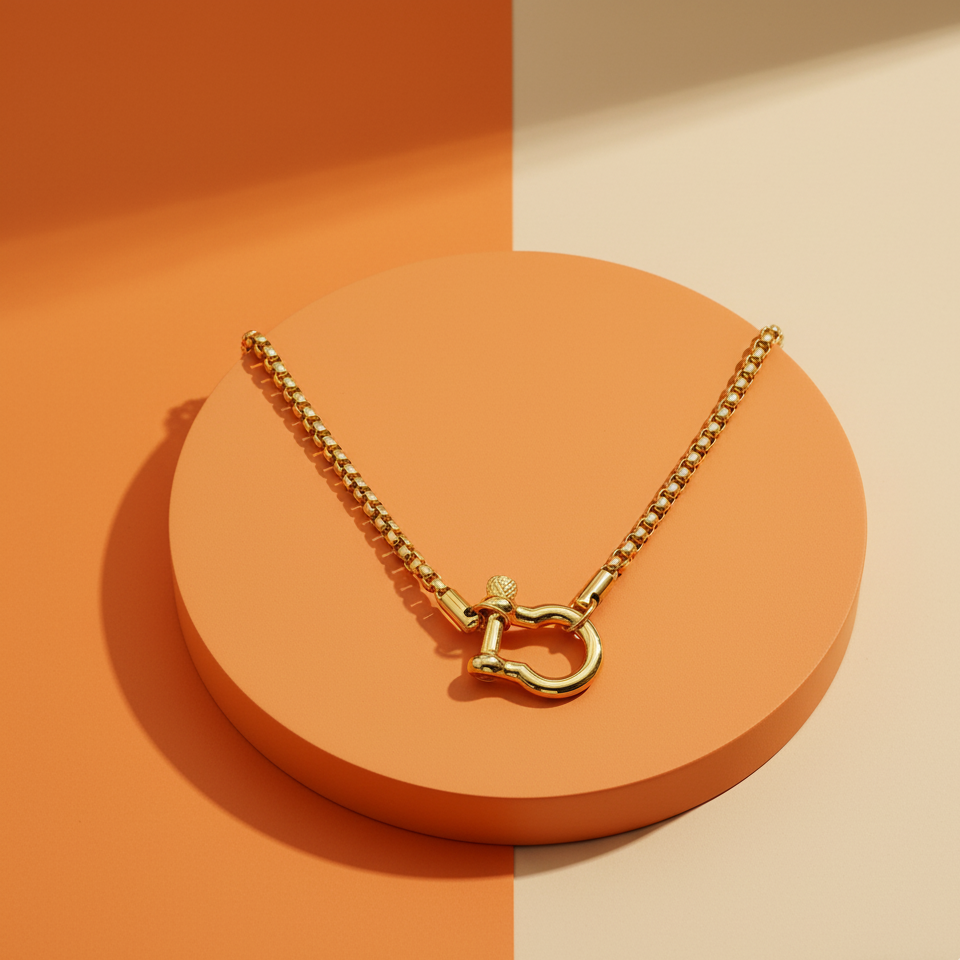
Streetwear already carries big graphics, so a pendant works best as a second, smaller focal point rather than a competing one. Because the trophy silhouette is dense and self-contained, the gold-tone version sits comfortably over a football jersey without fighting the crest or a printed back panel, as long as the metal provides the contrast. Against navy, black or deep red, the gold reads as a bright point; against cream or grey it reads softer and more tonal. Fashion design programmes such as FIT's trace how sports references move into everyday dress, and the practical takeaway is simple: the motif already carries cultural weight before any styling decision is made, so the pendant does not need to shout. The chain belongs to the same visual hierarchy. A matching stainless link chain keeps the language consistent — a hair-thin chain under a sculpted trophy looks mismatched, while the link chain reads as sport-adjacent and holds the pendant steady at chest height. The lobster clasp is a quiet practical win, since it comes off quickly when a jersey goes on or a gym session starts. In practice, one gold soccer trophy necklace over a crew neck or a jersey collar is enough: the depth of the form supplies the interest, and the scale stays modest. Exact dimensions and coating specifications sit outside the published spec, so scale is best judged from photos and one question to the maker rather than from a guess.
A miniature trophy earns its place in streetwear because of how it behaves, not how big it is. Layered planes give the eye more to read than a flat charm, rounded edges hold the outline together as the pendant turns, and a mirror-polished surface sends highlights travelling across the form with every movement. Put those three together and a small object holds attention at conversation distance without turning into costume jewellery. Readers comparing shapes can look at the World Cup Trophy Pendant Necklace details and judge the depth, edge treatment and gold tone against their own wardrobe before deciding.
A: It is a small object rather than a small picture. The trophy shape stacks a base, a narrowing body and a globe, so it offers overlapping planes, a visible shadow line and multiple edges to follow. That structure stays readable at necklace scale and keeps looking composed as the pendant rotates on the chain, which is why it holds attention next to a jersey print or a hoodie graphic.
A: A flat pendant tends to give one even wash of light, or a dull scatter if the surface is brushed or matte. Mirror polishing on a three-dimensional form creates several reflectors, so the highlight breaks into bands that slide across the body, the globe and the base as the wearer moves. The effect reads as changing light rather than a fixed bright patch.
A: Yes. The dense, recognisable trophy silhouette sits well over a football jersey or a crew-neck tee because it acts as a second focal point rather than competing with the main graphic. Contrast does the rest: a gold tone pops against navy, black or deep red and softens against cream or grey. The matching link chain and lobster clasp keep it easy to put on and take off around kit changes.
Sports and Intellectual Property | WIPO