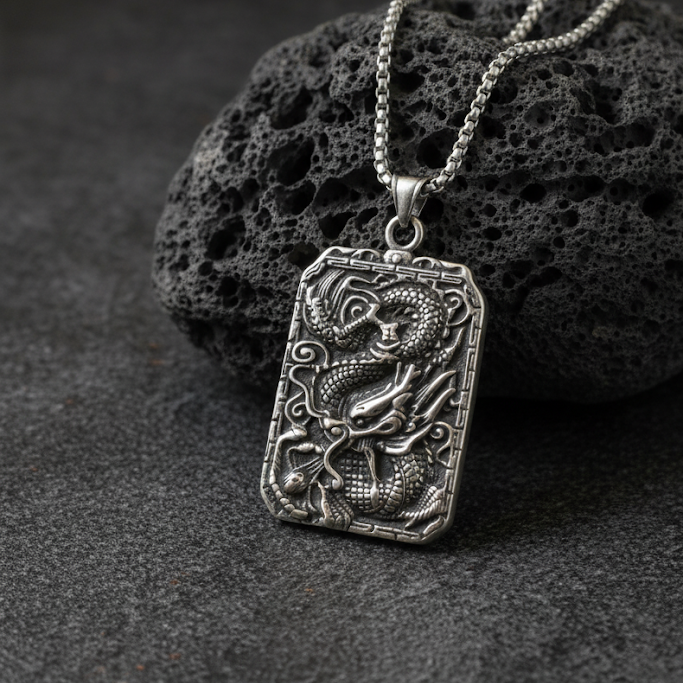
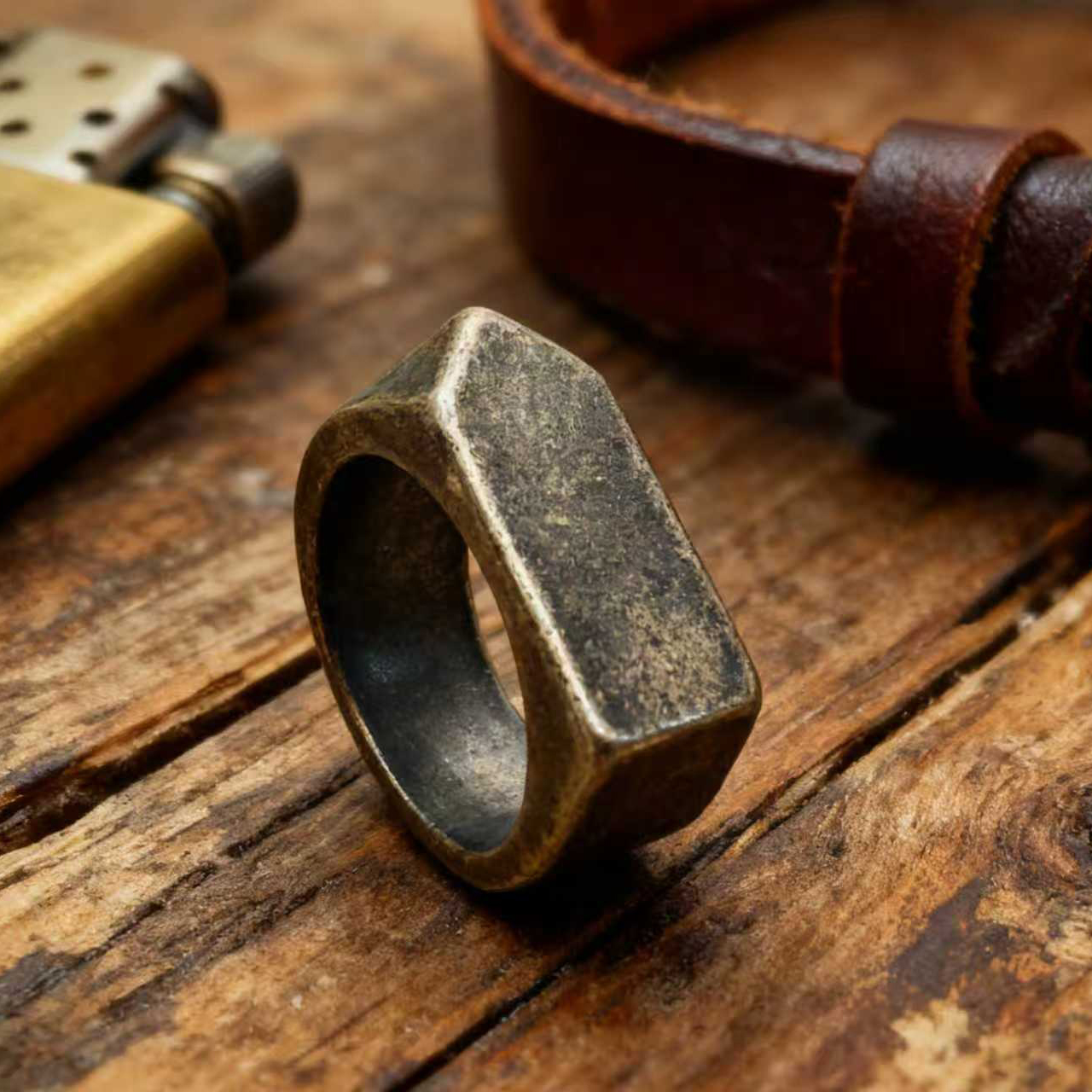
Introduction: A gold mechanical statement ring brings together a gold finish, a gear-derived silhouette, and the visual mass of a statement piece.
Most people meet this style at arm's length and reach for loose words: chunky, industrial, steampunk, edgy. Those words each point at a different layer of the same object, which is why two shoppers can describe the same ring in ways that barely overlap. Taking the term apart is the quickest way to see what actually creates the look, compare one ring against another, and judge whether a piece suits your own style. "Gold mechanical statement ring" stacks three meanings in a row — a finish, a borrowed motif, and a category of scale — and reading them in that order explains everything the ring does on a hand.
A statement ring is a category defined by presence rather than price or stone count. Jewelry has long served as a way to display identity and personal taste, and the V&A's history of jewellery frames ornament as exactly that kind of expression; the statement ring is the version of the idea built around size. What separates it from an everyday band is how much of the finger it occupies and how far away someone can recognize it. A thin band is read as a line. A chunky gold gear ring is read as a shape. That difference registers at conversational distance, long before anyone can see detail, texture, or craftsmanship. Visual weight is the practical measure behind that first impression. It combines how much metal the eye registers, how far the ring stands off the finger, and how much contrast the outer profile creates against skin. A wide, tall, sharply shaped ring occupies more of your field of view, so it competes with a watch, a bracelet, or a jacket cuff. That is why a statement piece usually works alone or with quiet companions: it already carries the composition. Scale is also why this style travels well as unisex design. Mass and silhouette do not carry the gendered coding that a small stone-set ring often does.
Mechanical is borrowed vocabulary. Gears are one of the most recognizable signs of how machines work — toothed wheels that mesh and turn at fixed intervals — and the association is strong enough that a toothed outline reads as machinery even when nothing on the object moves. A gear ring uses that borrowed sign. The piece is fixed sculpture, and the mechanical impression comes entirely from shape language: rhythm, depth, repetition, and edge.
The reason a toothed edge feels mechanical is recognition, not engineering. Anyone who has looked at a bicycle, a clock, or a can opener has learned that evenly spaced teeth belong to a part with a job to do. So when a ring's outer edge repeats that rhythm, the eye files it as a machine element before the brain gets around to calling it a pattern. That first read is what gives the ring its edge: it looks purposeful. Repetition matters more than any single tooth. The interval is the signal, in the same way a row of buttons reads as a control panel rather than as decoration.
Gold changes how that silhouette travels. A bright, warm, highly reflective surface throws strong highlights along ridges and deep shadow into recesses, so each step of the gear profile picks up a bright edge and a dark one right beside it. That contrast keeps the shape legible from across a room, where the individual teeth blur into a single toothed outline. Finish also shifts mood: the same profile in bare steel reads cool and tool-like, while gold pulls it toward jewelry. LUMIERE describes the Golden Gear Statement Ring as a 3D gear texture on a 316L stainless steel base with a vacuum gold finish — a 316L stainless steel gold ring in the descriptive sense, where gold is a surface layer over steel rather than solid gold. The 316L grade itself is simply a corrosion-resistant stainless steel family used widely in jewelry and hardware.
A plain band is quiet by design. Its surface is continuous, its silhouette is a simple curve, and nothing interrupts the eye as it travels around the finger. That is a different job, not a lesser one: the band recedes into an outfit and lets a watch, a cuff, or a gesture carry the attention. Put it beside a mechanical statement ring and the difference is structural. On the plain band, the shape is the minimum needed to keep metal on a finger. On the gear ring, the shape is the reason the object exists. You notice teeth, depth, and a profile that could not be mistaken for another ring across a table. An ordinary decorative ring usually applies a motif to a standard body. A stone goes into a setting, an enamel pattern sits on a shank, a small figure is soldered on top. The decoration is a passenger riding on the ring. A mechanical design inverts that relationship: the ring body itself is cut as the mechanism, so texture and structure are the same thing. That is why the style holds up in plain metal and survives without stones, engraving, or color. The one distinction worth keeping straight is that decorative gears are sculpture. Nothing turns, meshes, or drives anything. The ring borrows the look of a mechanism, not its behavior, and that is precisely what makes it wearable. Two smaller details complete the picture. LUMIERE describes a smooth comfort-fit inner band on this design, which sets a rounded interior against the heavy outer profile — a contrast you notice when a wide ring stays on the finger all day. The listing also presents the piece as unisex and suited to single wear or stacking, both of which follow from the same logic: a ring with this much visual weight can carry a hand on its own, or hold its own beside thinner bands. LUMIERE's copy also mentions tarnish resistance and skin-safety wording, which is brand description rather than an independent test result.
A gold statement ring earns the label through three separate decisions. Gold supplies a reflective finish that sharpens every edge. The gear motif supplies a recognizable mechanical sign, borrowed from machinery and translated into fixed metal. Scale supplies presence, so the piece is read as a shape rather than a line. Once you can name those layers, describing a ring becomes easy, comparing two candidates becomes fast, and you can tell immediately whether a design is a shaped mechanism or a decoration sitting on a band. The Golden Gear Statement Ring is a useful reference point for the first category, and its product listing is worth reading with those three layers in mind.
A: It refers to a visual code borrowed from machinery, mainly gears. The ring is shaped with a toothed, sculpted outer profile and repeated geometric forms that people recognize from working parts. Nothing in the ring needs to move for the effect to land; the impression comes from silhouette, depth, and rhythm. Gold describes the finish, a warm reflective surface that sharpens those shapes, and statement describes the scale. Mechanical here is a style term, not a function term.
A: No. A ring with working gears would contain separate parts that mesh and rotate. A jewelry gear ring is a single fixed piece whose outer body is formed to look like a gear. The teeth on LUMIERE's Golden Gear Statement Ring are part of the ring's own shape — a 3D gear texture rather than separate components. The mechanical look comes from that shape and from how light catches it, which is why the style can be judged by eye at normal viewing distance.
A: Scale decides how far away the ring reads as a statement piece, while gear texture decides what it says once someone is close enough to see detail. A wide, high ring with a toothed silhouette is visible across a room, and the gold finish adds bright edges that keep the shape legible from a distance. Made thin and plain, the same gear motif would become a subtle detail instead of the main event. Mass and texture together are what separate a gold statement ring from an ordinary decorative band.
Gears - How do they work? - Different types explained and compared
Stainless Steel - Grade 316L (UNS S31603)